At some point in your career, someone will say it.
“Why don’t we just get a grant?”
It’ll sound harmless. Sensible, even. Free money, public money, non-dilutive.
And if you’re moving toward VP of Engineering or CTO… that sentence is about to land on your desk. Let’s talk about what’s really going on.
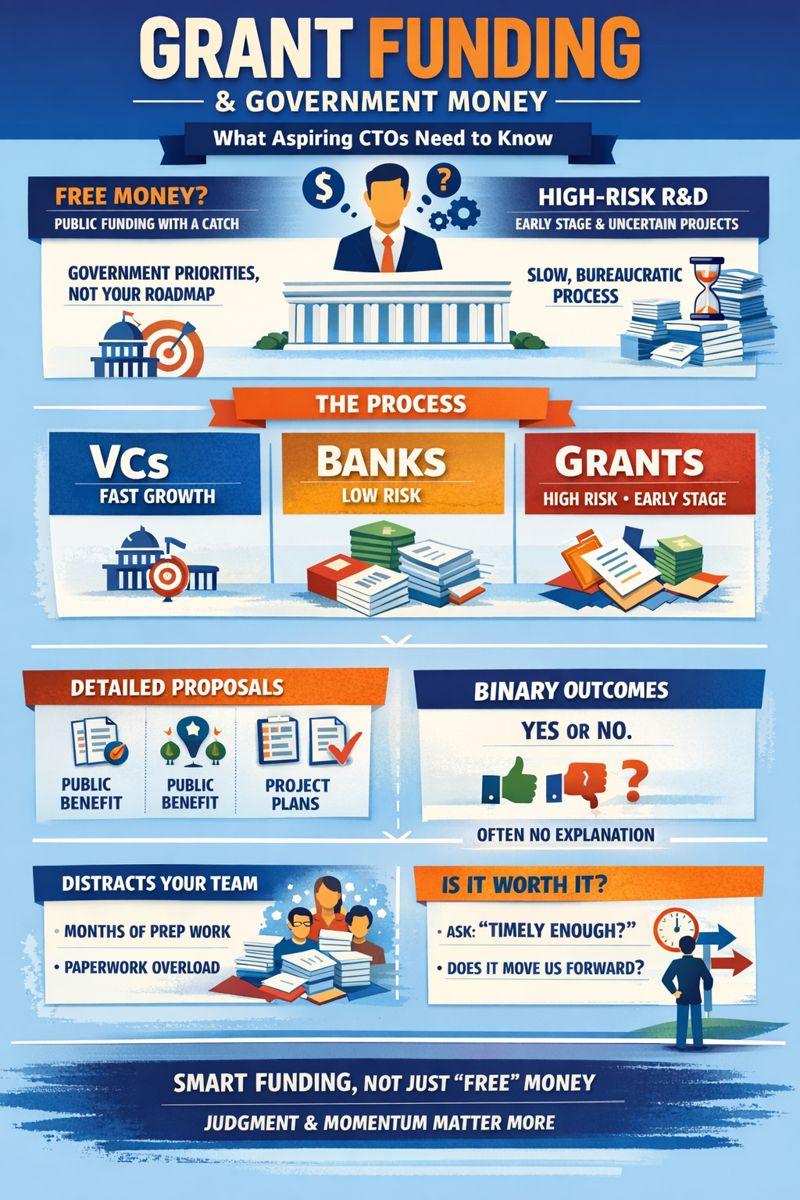
Grants feel like free money, but they’re not.
Yes, grants are public money won through a competitive process.
No equity. No repayment schedule. No VC on your board asking about CAC.
That’s the pitch.
But here’s the part engineers don’t hear early enough: grants are how governments steer behaviour.
They’re not funding your roadmap; they are kick-starting their priorities. Climate tech. Advanced manufacturing. AI safety. Domestic supply chains. Whatever problem is politically or economically hot right now.
If your work lines up? Great, but if it doesn’t, you’ll be bending it until it does. And bending software plans is never free.
How grants fit next to VCs, banks, and angels
Once you sit closer to exec conversations, you start seeing the capital stack differently.
VCs back speed. They want growth, scale, and optionality.
Banks back predictability. Low risk. Clear repayment. Boring is good.
Angels tolerate chaos. Higher risk, smaller checks, often with tax advantages to soften the blow.
Grants live in a different universe because they fund high-risk, early R&D where outcomes are unclear and timelines are fuzzy. This is the kind of stuff no rational lender would touch. This same stuff VCs won’t fund until it’s de-risked.
Which sounds perfect for engineering… until you realize what that means operationally.
The hidden cost: attention
Government grants take time.
A lot of it.
Not a few meetings of time. I mean months of reading documentation, interpreting questions that feel like they were written by three committees and a lawyer, and aligning internal people who already have full-time jobs.
You’ll be asked to explain:
- The scope of the project
- Why it matters to the public
- Why you are uniquely qualified
- Who’s on the project (and their resumes)
- Project plans
- Gantt charts (yes… still)
- Financials down to the dollar
All before a single line of code ships.
And the response? The response is usually binary: yes or no. Sometimes with no explanation at all. That can mess with a team if you’re not careful.
The emotional trap engineers fall into
Here’s the dangerous part. Grants feel earned. You wrote the proposal. You justified the architecture. You explained the risk.
So when you don’t get it? It feels personal.
I’ve seen senior engineers spiral over rejected grants more than failed launches because launches fail in public, for understandable reasons. Grants fail quietly and arbitrarily.
As a leader, you can’t let that bleed into morale or momentum.
“We can just hire someone to handle it”
There are firms and agencies that help secure grant funding. These firms know the language, the reviewers and the keywords that unlock points. But, they also take a percentage.
Sometimes that’s worth it. Sometimes it’s just outsourcing confusion. The real unlock is having a dedicated project manager internally whose job is to protect the team from the administrative blast radius.
Without that? Engineering becomes the path of least resistance. And suddenly your senior devs are editing Gantt charts instead of shipping value.
That’s how resentment starts.
The question a CTO actually needs to ask
Not “Can we get the grant?” Ask this instead:
Is this grant timely enough to justify the effort it will consume?
Grants don’t just fund projects. They delay decisions. If your company needs clarity, speed, or focus… a grant can work against you. If you need runway to explore something truly uncertain, and the business can absorb the distraction… it can be powerful.
Context matters. Timing matters more.
A quiet leadership shift
Here’s the levelling-up moment most engineers miss. As a CTO or VP of Engineering, your job isn’t maximizing funding. It’s maximizing useful momentum.
Sometimes the smartest move is saying no to free money.
Because it isn’t free if it pulls your team away from what actually compounds.
That judgment call? That’s executive work. And once you make it a few times, you start seeing the game differently.