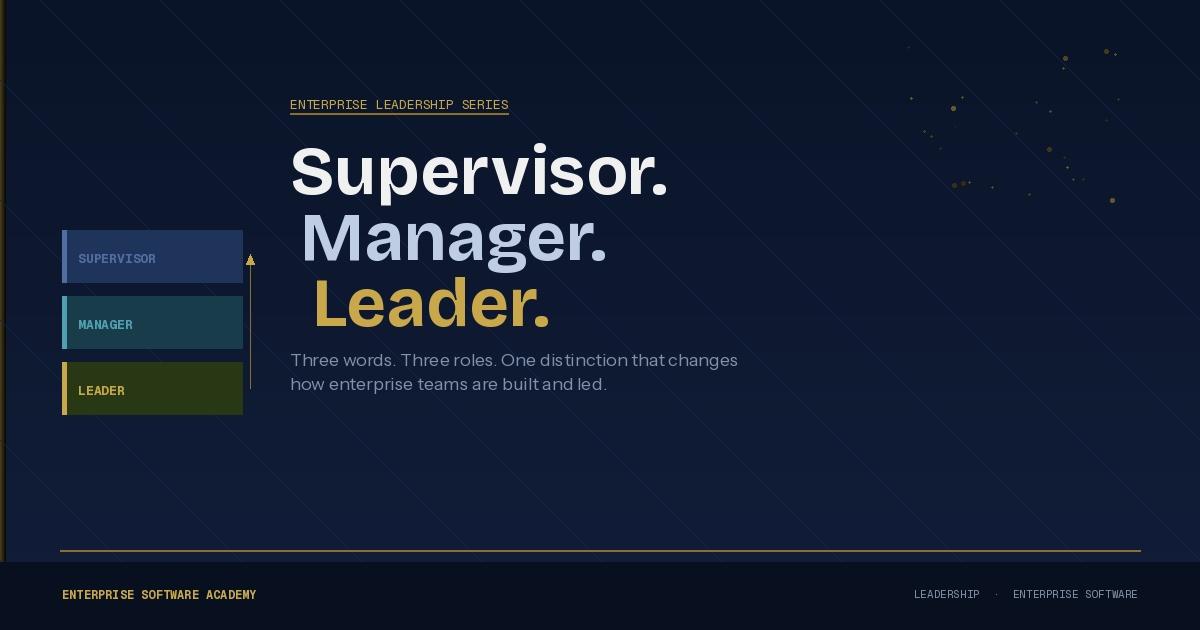
Supervisor, Manager, or Leader: What’s the Difference, and Why It Matters in Tech
Technology Leadership · December 8, 2025
Sharing is Caring
Most people use these three words interchangeably. That’s a mistake, and in a technology context it’s an especially costly one. The blurring of these roles is part of why so many engineering teams are well-staffed but poorly directed, and why so many technically excellent people burn out trying to figure out why nobody seems to be actually leading.
Let me break down what each term actually means, and then ground it in the realities of enterprise software.
The Supervisor
A supervisor is responsible for overseeing a group and ensuring that work is being done as expected. That might sound simple, and honestly, the role sometimes is. Supervisors watch for gaps, flag issues, and keep things on track. Some people hear “supervisor” and immediately think of hall monitors or middle management clichés.
That reaction is understandable, but it misses something important.
Supervision is often the entry point into broader responsibility. It is where people start learning how to observe a team, identify problems before they compound, and understand that accountability extends beyond their own output. Many team leads in technology, a lead software engineer, a senior QA engineer who unofficially owns a testing process, are supervisors in practice, even if nobody ever uses that word.
The mistake is treating this role as a ceiling. It isn’t, it’s a foundation.
The Manager
Management gets a bad reputation, often for good reason. We have all encountered managers who treated the role as a combination of attendance-tracking and bureaucratic enforcement. That version of management is not what I’m talking about here.
A genuine manager is entrusted with resources and accountable for outcomes. Their job is to allocate those resources effectively, whether that’s people, budget, time, or technology, and to direct them toward meaningful results. That requires judgment. It requires an ability to understand constraints, prioritise competing demands, and make calls that not everyone will agree with.
In enterprise software, this often shows up in contexts like:
Engineering Managers who aren’t just scheduling standups but are actively making decisions about team structure, technical debt prioritisation, and how to balance delivery speed against long-term system health.
Product Managers who sit at the intersection of business outcomes and engineering capacity, constantly translating between stakeholder expectations and what the team can realistically build.
Program Managers and PMOs in large organisations who are managing dependencies across multiple teams, vendors, and release cycles simultaneously.
What all of these have in common is accountability for outcomes rather than just activities. A manager’s measure of success isn’t “did people show up?” It’s “did we ship the right thing, on a timeline that made sense, without destroying the team in the process?”
The Leader
This is where it gets more interesting, and more personal.
A leader sets direction. They define what success looks like, articulate why it matters, and help others understand how to get there. They don’t need to have every answer, and they don’t need to do every task themselves. What they need is clarity of purpose and the ability to communicate that purpose in a way that actually motivates people.
In a technology context, leadership shows up in some specific and recognisable ways.
The Principal Engineer who shapes architectural direction. They’re not managing anyone formally. But when they walk into a design review and articulate a vision for how the system should evolve over the next three years, the room changes. They’re leading.
The Engineering Director who removes blockers. Not micromanaging the solution, but identifying that a cross-team dependency is stalling delivery, making the call, having the conversation that needs to happen, and clearing the path. That’s leadership in action.
The CTO who builds a culture of accountability. Not just setting technology strategy, but modelling the behaviours they expect. Saying “I don’t know, let’s find out” in a room full of executives. Prioritising a post-mortem over assigning blame when a production incident occurs. Creating the conditions where engineers feel safe raising problems early.
Leadership also carries a strong human element that gets underemphasised in technical environments, where the tendency is to focus on systems and output rather than people.
Strong leaders pay attention to morale. They notice when someone is struggling before that person says anything. They invest in developing others, not because it looks good on a performance review, but because building future leaders is part of what a leader does. And when someone’s path no longer aligns with the team’s direction, they handle that transition with professionalism and respect rather than letting the situation drag.
How These Roles Show Up in Enterprise Software
Here is where the distinctions become practically useful.
Enterprise software environments are complex. You have large codebases with years of accumulated decisions. You have stakeholders who understand the business deeply but may have limited technical context. You have vendors, integrations, compliance requirements, and the constant pressure of keeping existing systems stable while simultaneously modernising them.
This environment creates a specific set of leadership challenges that smaller organisations rarely face.
Ambiguity at scale. In a startup, the path forward is often obvious or at least fast to discover. In an enterprise, the path forward involves navigating organisational politics, legacy constraints, and competing priorities across divisions. This is where leaders earn their value. They provide direction when the environment resists clarity.
The technical credibility problem. Senior engineers in enterprise environments are often the most capable people in a given room, technically speaking. But technical capability alone doesn’t translate into leadership. I’ve seen brilliant architects who were technically excellent and effectively invisible as leaders because they couldn’t translate their knowledge into direction that non-technical stakeholders could act on. Leadership in this context means bridging that gap deliberately.
Long-cycle work requires sustained vision. In enterprise software, meaningful initiatives take months or years, not sprints. A team implementing a new ERP module or migrating a core platform to the cloud needs more than a manager coordinating tasks. They need a leader who can hold the destination in view, communicate progress meaningfully, and sustain motivation through the long stretches where things are hard and the finish line isn’t visible.
Distributed teams and matrix structures. Many enterprise software professionals are working in environments where they have influence without authority. A technical lead on a programme may be coordinating work across teams where they have no direct reports. A solutions architect may be responsible for the technical coherence of a system built by multiple vendors and internal teams simultaneously. This is leadership without a title, which is exactly the kind of leadership that matters most.
Leadership Is Behaviour, Not Title
This is probably the most important point in this entire discussion.
I’ve worked in enterprise environments long enough to have seen every variation of this. VPs who managed but didn’t lead. Team leads who had no formal authority but shaped the direction of their entire programme. Architects who were technically brilliant but couldn’t bring a team along with them. Individual contributors who, through consistency and clarity, became the people others turned to when something important needed to happen.
Leadership is defined by behaviour. It is demonstrated through the questions you ask, the decisions you make visible, the way you handle uncertainty, and how you treat the people around you.
If you’ve worked with someone who called themselves a leader but didn’t act like one, that’s frustrating. It’s also common. It doesn’t invalidate the concept. It simply reinforces that leadership isn’t conferred by a job description.
If these behaviours align with how you want to operate, don’t let the poor examples you’ve seen put you off. The people who consistently demonstrate leadership in enterprise software environments, regardless of their title, are the ones who tend to shape those environments over time.
Where Do You Sit?
It’s worth thinking honestly about this, not as a judgment, but as a diagnostic.
Are you primarily overseeing and tracking? You’re operating as a supervisor. That has real value, especially at scale, but it’s a starting point, not an endpoint.
Are you accountable for outcomes and making resource decisions? You’re managing. The quality of your management will show up in the results your team produces and the health of the team producing them.
Are you setting direction, developing others, and removing obstacles so your team can do meaningful work? That’s leadership. And in enterprise software, that’s the capability that organisations are genuinely underserved on.
Most of us will operate across all three of these modes at different points. The goal isn’t to choose a lane and stay in it. It’s to understand what each requires, develop the capabilities intentionally, and be honest about where the gaps are.
That’s what separates people who progress in this industry from people who plateau.
Wrapping It Up
Supervisor, manager, and leader are not interchangeable terms, and treating them as such is part of why so many technology organisations struggle to develop the people and direction they need.
Supervision builds awareness. Management drives outcomes. Leadership sets direction and develops the people capable of getting there.
In enterprise software specifically, the gap between having managers and having leaders is often the difference between a team that ships and a team that compounds. The technical complexity is high enough, the timelines long enough, and the stakeholder landscape complicated enough that direction and human investment matter as much as execution.
None of these roles require a title. All of them require intention.
If you’re a senior engineer, a product leader, or an executive in an enterprise software environment, you already have more opportunity to lead than your org chart suggests. The question is whether you’re choosing to exercise it.