At some point in your career, something subtle shifts. You’re still thinking about architecture. Still reviewing pull requests. Still worrying about outages at 2 a.m.
But now there’s another question floating around in the background. “Is this actually a good use of the company’s money?”
That question doesn’t show up in Jira. It shows up in board decks. And one of the cleanest ways executives answer it is with Return on Equity.
Not because it’s fancy. But because it’s brutally honest.
First, the uncomfortable framing. Bill Graham said it best:
“Investment is most intelligent when it is most business-like.”
That sentence hits different once you’re sitting closer to capital allocation than code reviews.
Because whether you like it or not, a company is a machine for turning resources into value.
And at the executive level, you are part of that machine.
So let’s ground ourselves.
Assets: everything the company owns. Code, cloud infrastructure, machines, IP, and people’s time.
Liabilities: everything it owes: debt, obligations, future commitments.
Equity: what’s left. The residual value that belongs to shareholders.
The accounting identity is boring… and powerful:
Assets = Liabilities + Equity
Nothing magical. Just conservation of value.
What ROE is actually asking
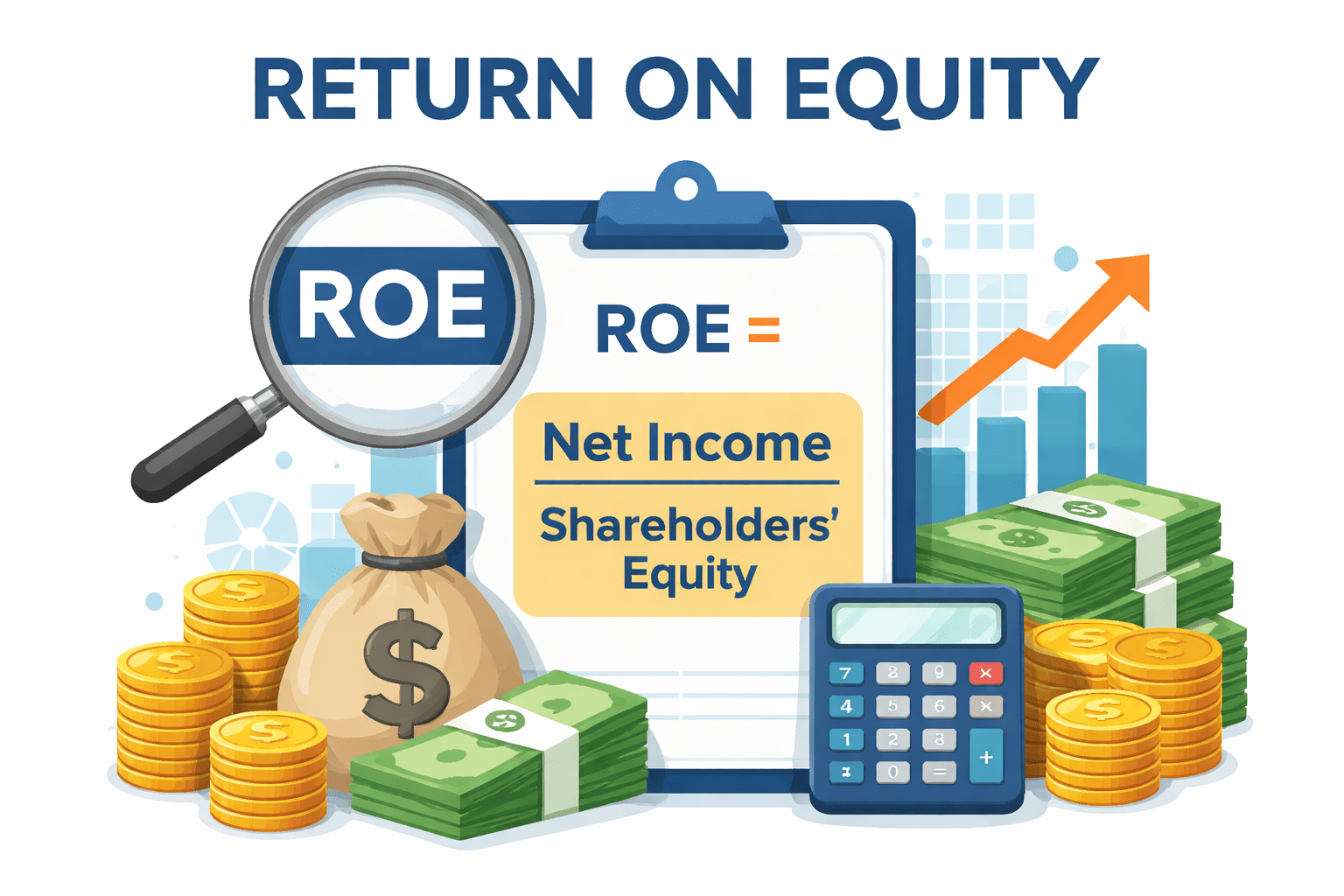
Return on Equity = Net Profit / Equity
That’s it. And yet this single ratio answers a question that keeps CEOs up at night:
“For every dollar the owners have tied up in this business… how hard is that dollar working?”
A high ROE indicates the company is efficient. Low ROE means something is stuck. Or bloated. Or misallocated.
Think of equity like pressure in a hydraulic system. The same pressure can move a lot… or barely budge anything.
Why senior engineers should care (even if you don’t want to)
When you’re a developer, efficiency feels local. Developers might ask questions like these:
- Is this function clean?
- Is the service fast?
- Did we avoid tech debt?
As you move toward VP or CTO, efficiency becomes systemic. A CTO or VP of Engineering might ask:
- Are we hiring faster than we can onboard?
- Are we building features faster than sales can sell them?
- Are we burning senior talent on low-leverage work?
ROE is what happens when all those decisions collapse into a single number.
And no, finance won’t explain that part to you; they’ll show the ratio.
Dupont Analysis: pulling the machine apart
ROE looks simple. Too simple.
So finance does what engineers do best.
They decompose it.
Dupont Analysis breaks ROE into three levers:
Translated into human terms:
- Profit margin
Are we actually making money on what we sell? - Asset efficiency
How hard are our tools, systems, and people working? - Financial leverage
How much risk are we taking on to amplify returns?
This is where technical leaders quietly start to matter a lot.
Because you don’t control leverage.
You influence everything else.
A cleaner architecture improves asset efficiency.
A focused roadmap improves margin.
A chaotic platform erodes both slowly and invisibly until ROE tells on you.
Return on invested capital: where engineering really shows up
ROE is the headline. But Return on Invested Capital (ROIC) is where execution gets exposed.This strips out financing games and asks a sharper question:
“Given the capital tied up in actually running this business… what did we get back?”
This is where bloated platforms hurt.
Where half-finished migrations hurt.
Where “we’ll clean it up later” quietly compounds.
Every unused system is capital doing nothing.
Every over-engineered solution is equity on idle.
The hurdle rate nobody tells you about
Here’s the part most engineers never hear until it’s too late. Every company has a hurdle rate. An implicit minimum return that says:
“If this investment doesn’t beat this, we shouldn’t do it.”
It might be 8%, it might be 12%. In a PE-backed environment it’s most likely higher. You won’t see it written on the wall. But it’s always there… judging.
Which means every major technical initiative is competing against:
- paying down debt
- acquiring another company
- or just… not spending the money at all
That’s the real competition.
Time is the silent variable
Finance people obsess over this formula:
Engineers feel it intuitively.
A dollar earned five years from now is worth less than a dollar earned today.
A platform rewrite that pays off “eventually” is riskier than one that improves margins this quarter.
Time discounts everything including good intentions.
What this means for you, practically
If you’re aiming for VP or CTO, ROE isn’t about becoming a finance person.
It’s about changing how you frame decisions.
You stop asking:
“Is this technically elegant?”
And start asking:
“Does this increase the return on the capital we already have?”
Sometimes the answer is yes. Sometimes it’s painfully no.
And learning to see that distinction… to feel it in your gut before the spreadsheet confirms it…
That’s the real promotion. Not the title. Not the org chart.
The shift in how you think about value.